Sunday, January 15, 2023

The Tender Bar


If a picture is worth a thousand words, this one tells a few stories. Behind the bar at the Old Spaghetti Factory Restaurant downtown San Jose, 1974, with Mary the cocktail waitress.
PHOTO: BOB BROWN

I spent more than two years of my life as a professional mixologist.

That's a fancy name for bartender, or as some of my most trusted clients called me: barkeep. I called them regulars.

I mixed tequila sunrises, Singapore slings and margaritas, the popular cocktails of the day, as well as traditionals like daiquiris, old-fashions, sidecars, Tom Collins's, Black Russians, Manhattans, whiskey sours, screwdrivers, Rob Roys, rusty nails, Irish coffees and of course martinis.

"Do you know how to make an extra dry martini?" an elder gentleman outfitted in a blazer and ascot asked me.

"Hold a bottle of dry vermouth above the glass and whisper, "vermouth."

Each libation corresponded to a particular glass. A martini "up" went into a stemmed glass, flared like the opening of a lotus on top to accept and cradle the alcohol. 

Tending bar was much like attending school. Although you didn't know if you were student or teacher. Roles were interchangeable. Although I'm sure I learned more than I taught. 

My first gig "dancing the slats" was in 1973 for the Old Spaghetti Factory in San Jose, a themed establishment replete with antiques, faux Tiffany lamps and an authentic, richly wooded back-bar that had been trucked down from Marysville, California, Gold Rush country. It became a nugget of conversation for antique collectors who dropped in, as well as diminishing members of E Clampus Vitas. 

Clampers, as they're called, are dedicated to the preservation of the old American West, with particular fondness for the California Mother Lode. Clampers are recognized as both an historical drinking society and a drinking historical society. 

Rule number one: A serious barkeep should not drink with customers while on duty.

Theme restaurants were popular in the 70s. As part of an effort to revitalize downtown San Jose (which continues to this day), the novel Old Spaghetti Factory attracted a broad audience of dinner-goers and downtown drinkers. The once-agrarian town and surrounding region was known as Santa Clara Valley, the Garden of Earthly Delights. Silicon Valley existed, not as a name but as an underground of brainiacs developing tiny chips that would eventually alter the world. But we didn't know that.

I did know that the oldest daily newspaper in the state of California, once located around the corner, had picked up stakes and relocated to the outskirts of town between a bucolic abandoned farmhouse and an alfalfa field. The San Jose Mercury and News, morning and evening dailies, ten editions each day, were being produced in a new, modern one-story building with a moat in front, a la Sleeping Beauty’s Castle. With a lighted abstract sculpture in its portico, the newspaper plant shined like a beacon. Perhaps it was a warning.

I knew this because for two-and-a-half years I had been employed in that castle as a promotion writer.

During that time the newspaper's voice reflected the prune-picker heritage of old San Jose, with a front page column by Dick Barrett, who spoke the voices of Ma and Pa and the good ole days. Mainstream newspapers, like the Merc, took politically conservative editorial positions, while the cultural changes of the Sixties and early Seventies remained more of a derisive curiosity.

The spiffy newspaper plant was a harbinger for the invasion of high-tech campuses throughout the region. Today that newspaper building houses Super Micro, a chip manufacturing facility from China. I have no idea where the newspaper relocated. The internet has decimated a 300-year-old industry.

On an otherwise sunny day in September of 1972, I walked away from my job at the Murky News. I had had enough, the final straw being more criticism of the increasing length of my hair. My partner Tom Graham likewise stepped away from his typewriter. Computers weren't introduced at the newspaper until 1976. Together we merrily skipped over the watery moat as we plotted our futures, which would involve Volkswagen buses, restaurant work and much longer hair. 

"If you're going, I'm going," said Tom. 

Jim Schober, personnel manager, tried to talk us out of leaving. "You don't want to do this," he said.

"Yes we do," came our chorus.

We received a write up in the Guildsman, an internal newsletter published by union members who posed an adversarial stance against management. Tom and I were referred to as an example of a continuing "talent drain" at the newspaper. 

I was married with a three-year-old daughter, Molly. My employment had been my first career job out of college. Linda, my wife and high school sweetheart, encouraged me to quit the newspaper, primarily due to my complaining about the politics, while her unhappiness seethed below the surface.

Tom, Linda and I all found ourselves employed at the Spaghetti Factory, he and Linda waiting tables, me behind the bar. During that period, Linda became pregnant with our second child, Vanessa, and quit working.


Bar Talk

In a sense, the newspaper followed us. Those bar regulars were mostly reporters and public relations pros seeking post-deadline refreshment, a place to tell stories, laugh and linger over a glass or bottle while inhaling the aroma of garlic from the kitchen that mingled with the reek of the Lysol-scrubbed floor. It smelled better than ink and the clatter of typewriters after a few.

That hour of conviviality transpired between the time we opened and the time the dinner crowd arrived for spaghetti. You could still hear the sound track piping in soft rock music. The bar served as the welcome waiting room.

The above photo was shot by Bob Brown, a two-fisted PR gadfly who bellied up to the bar with a Nikon in one hand and a vodka-grapefruit in the other. The cocktail would have been called a Salty Dog but Bob didn't want the rim of his glass salted like a margarita.

"No salt," said the salty Brown, his blue eyes searching the room below his carrot-colored brows. He wore a navy sport coat, his necktie removed, his pink lips pursed, about to spread into a chuckle or smirk. 

Most customers left loose change on the bar as a tip. Some would lay down a much appreciated greenback. Cocktail waitresses tipped the bartender a percentage of their tips, based on their own discretion.  Our roles were defined and never questioned: women served the tables and men poured the drinks.

The Electric Light Tower in San Jose, Calif., circa 1905, after which the Tower Saloon on Santa Clara Street was named.   PHOTO: SAN JOSE LIBRARY ARCHIVES

A twenty-something Tom McEnery, tall and clean-cut, with an air of privilege and the blood of an Irishman, dropped in occasionally. Tom had politician written all over him, even puffed a long slender cigar. He would later become mayor of San Jose during its period of rapid growth and booming high technology. 

"I'll have a scotch and water," he said, adjusting himself at the bar, personable and forthcoming. I had him pegged for governor.

His family owned properties downtown, including the renowned Tower Saloon, a well-appointed watering hole named after the famous tower that once hovered over the central intersection in town, at Market and Santa Clara streets. During his mayorship, McEnery properly recused himself on matters related to downtown real estate.

Local politicos met at their own table in the saloon, among them Mayor Norm Mineta, who would later serve as cabinet secretary for Presidents Bill Clinton and George W. Bush. The Norman Y. Mineta International San Jose Airport was named in his honor. Of Japanese ancestry, Mineta was hailed as the first Asian-American to hold those offices.

Adorned in shades of red and gold and drowned in bar chatter and the pounding of leather dice cups on the mahogany bar, the Tower Saloon served as an after-hours haunt for local restaurant staff. The real party started when the doors were locked at 2 am and the jukebox was turned up with thumping soul-funk music. I mixed a few at the Tower. 

Rule number two: Repeat rule number one.


The Jocks

The Tower Saloon had its allure, but tending bar at a popular restaurant was most fun. I enjoyed the busy atmosphere of the Spaghetti Factory and variety of customers, never knowing who might stop by. I met and became friends with Al Feuerbach, an elite track and field athlete who held the world record in the shot put. He, Brian Oldfield and Bruce Jenner worked out together at Bud Winter Field at San Jose State in preparation for the 1976 Olympic Games in Montreal. However, the Olympic Committee had banned Oldfield from the Games because he had competed for money in a brief, ill-fated professional track and fileld circuit.

I wrote a piece about Feuerback, an amiable, long-haired hippie jock. I tried, unsuccessfully, to sell it to Sport magazine. I interviewed Jenner with his first wife Chrystie at their very modest apartment in San Jose for a potential story that never gelled. Neither piece had a news hook. I profiled the colorful and controversial Oldfield in an article that did sell, twice. 

The following summer in Montreal, Feuerbach finished fourth in the shot put. Oldfield, also a shot putter who revolutionized the event by introducing a spinning approach-release, appeared in a televised advertisement for Kodak. Jenner, an extremely good-looking guy, won the grueling two-day decathlon that launched his celebrity. 

At the Spaghetti Factory the crowd moved through, never over-staying their welcome. The job required multi-tasking while dancing in a tight narrow space: Greeting newcomers, fulfilling orders for the wait staff, chatting with people looking to have a good time. I reveled having a stage and audience.

My final gig as a mixologist was at the nearby Laundry Works restaurant, developed by Vic Chung, a restaurateur who had started the popular Iron Works restaurant in Palo Alto, both featured a nouveau California-style cuisine. Vic had frequented the Spaghetti Factory while the Laundry Works was under construction. He asked me to come over. He drove a baby blue Porsche with the vanity plate, Bru Max, which scored a mention in Herb Caen's iconic three-dot column in the S.F. Chronicle.

I worked mostly day shifts at the Laundry Works -- a lunch crowd of mostly lawyers (bad tippers) from the nearby county courts  -- while focusing on moving away from the bar bizz. The party atmosphere had run its course. I had a family to support -- a wife and two young girls -- from whom I had been briefly separated due to circumstances of my employment and other unexpected family matters. Having married at ages 21 and 20 did not work in our favor.

Desperately seeking alternative employment, at the last minute, I turned down a public relations position with FMC (Food Machinery Corp.), a major employer in San Jose that manufactured a variety of machines, including the Bradley, a modern tank-like weapon of war. I couldn't do it.

At age 28, I felt lost and trapped.

Rule number three: Expect the unexpected.


To be continued.


Saturday, January 7, 2023

Atmospheric Shiver

A couple of days ago when I heard that Soquel Creek had breached at the Soquel Grange, I experienced deja vu. In 1982 this was the scene on Monday, Jan. 4 following more than 36 hours of continuous rain in Santa Cruz County. Our Santa Cruz Publishing offices were located across Porter Street from the grange. We had to evacuate. PHOTO:KCS


"They say it's a hundred-year storm, but I say bullshit. It's what happens when you live in a floodplain." -- merchant, Soquel village, 1/8/82


"A state of emergency in Santa Cruz County was declared by Gov. Edmund Brown, Jr. and President Ronald Reagan, following the worst flooding ever in parts of the county." Santa Cruz News, 1/8/82


They called it the Pineapple Express then. Today they call it an Atmospheric River.


Front page of The News, Jan. 8, 1982

We published that week's News on the fly. Our offices were thrashed. Water had risen to four-feet on the inside walls. We did not have computer technology. Composing a newspaper for printing required several hand-operated steps including typesetting and paste-up. -- between the time the story left the typewriter until it reached the printing press. Somehow we did it. Publisher/owner Lee May found a way and we all pitched in using facilities of the Aptos Post.

The destruction throughout Santa Cruz County was similar to what happened this week, worse in the mountains: Downed trees, tons of driftwood floating into Monterey Bay and washing up on local beaches and roads. We lost power for longer periods. Ten people were were buried alive under a mudslide at Love Creek. For many old-timers, it brought back memories of the flood of '55 which submerged downtown and wiped out China Town next to the San Lorenzo River.

The loss of life from the Atmospheric River is one. A 72-year-old man was crushed by a falling tree. We have not seen the likes of the current storm in 41 years. Drought throughout California has not only kept us too dry, but dulled our memories to how powerful and destructive Pacific Ocean storms can be along our Monterey Bay coastline. Rain storms were once common winter occurrences.

Fallen tree in Lighthouse Field State Park marks spot where man died. PHOTOS:KCS 2023 

Car driver stops suddenly to avoid crashing surf.

Onlookers watch waves pelt the cliffs and West Cliff Drive.

Pedestrian-Bike path on West Cliff Drive destroyed by heavy storm surf.


Nothing but white water at Mitchell's Cove.


Another storm is due tonight with a week of rain. Here's hoping we stay safe and dry, and that our reservoir at Loch Lomond reaches capacity. Latest report is at 90-percent.


Thursday, December 1, 2022

What’s in a Blog?

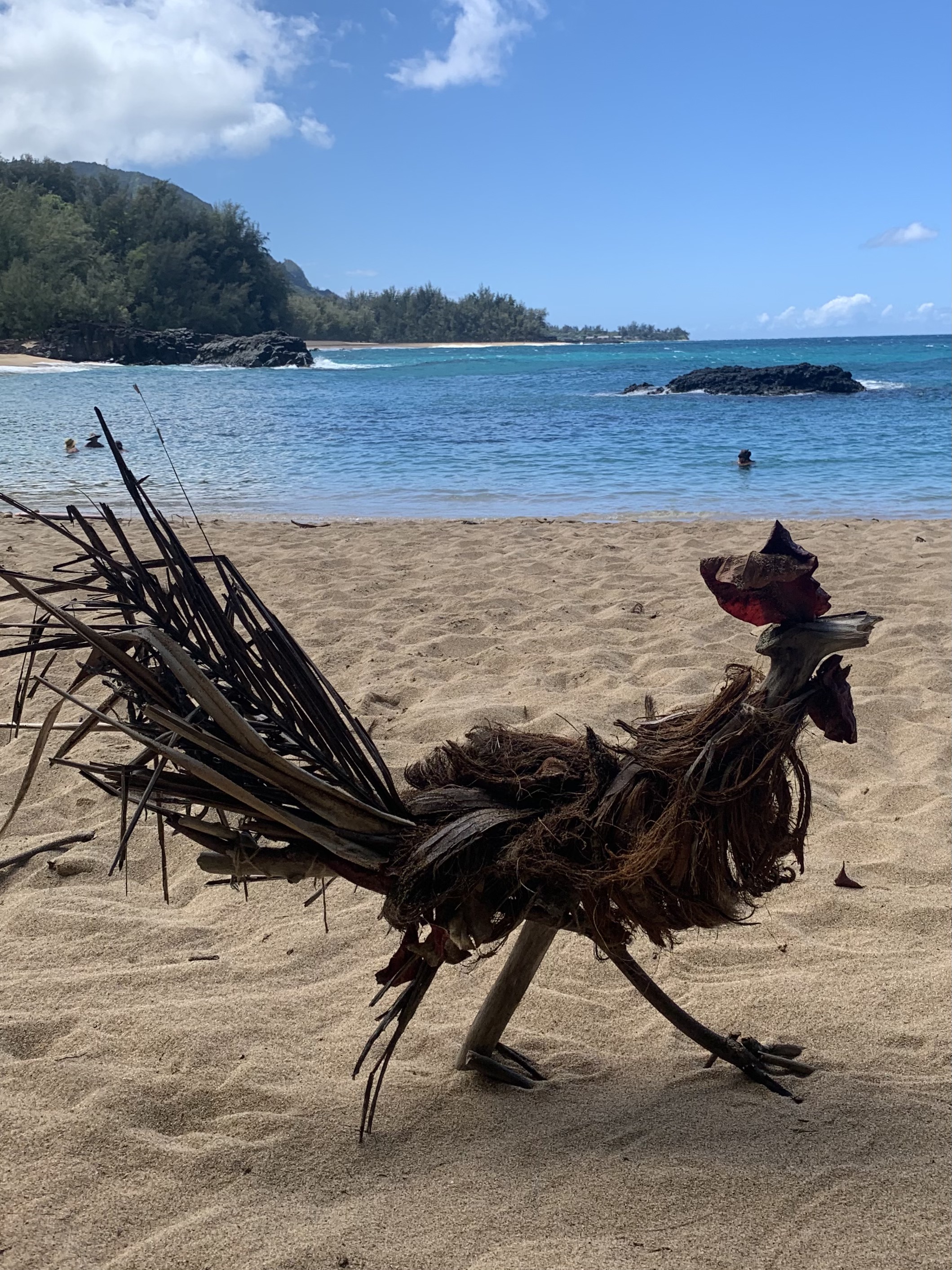
Rooster made from flotsam found on Lumahai Beach, island of Kauai, where the movie South Pacific was filmed.  PHOTO KCS


THIS BLOG turns 6-years-old on December 14.

I had finished two previous blogs about my road trips to New Mexico and Montana. Both blogs are accessible through my profile info *, entitled Thunderbird at High Noon and Montana Moonrise. In order to blog, you must register a name for your blog. It's shocking how many names are already taken which leads to some wild brainstorming.

Thunderbird at High Noon? It didn't make sense to me either until I met the Thunderbird in Shiprock, AZ.

As far as blogging in general, I had no idea what I was doing. Still don't. I simply see a blank space and figure I can fill it with whatever I want: words, photos and videos, play a little with the type font and not have an editor looking over my shoulder, fiddling with my words. This is a luxury. It's also a risk. A blogger is like a trapeze artist without a net. Ouch! Those misspellings, grammatical errors and factual missteps can hurt. You're a committee of one.

If you do go back to my earlier blogs you will see weird spaces in some places where cool photos once were. I thought I had been hacked but I think I lost the photos due to my misunderstanding of how blog photos are stored. I hope to retrieve those photos if I can figure out that trick.

While employed, I looked forward to the day when I would be able to surf during hours of the day when most folks were busy at work or school, when fewer people would be in the water. It sounded like heaven, not having to deal with crowded lineups. 

I decided to name my new blog Talking Surf Stories and write about surfing from the perspective of the soul surfer, basically the everyperson surfer who enters water for fun, as opposed to the pros who are out to compete and local-break enforcers who enter with entitlement, not a smile.

My subject would include talking about the moods of the tides, swells and storms that we rely on for waves, a love for the ocean, the joy, regeneration and comaraderie that we draw from it.

That was the central topic of this blog for the first two years, before I started to write about more personal stuff, like friends and music and other non-surfing subjects. Then COVID hit, sheltering and work furloughs began and throngs of wannabe surfers flocked to the water where they could play outdoors. Surf breaks became more loaded than ever, including during those heretofore empty pockets of time only a few could fill.

Barbara and I were essentially trapped in Paradise on the island of Kauai. A tough sentence but somebody had to be there. Our flights home were canceled. I blogged everyday about our situation, not about surfing. Life since then has not been the same. My focus changed and so did my blog, but not the title.

So I've made a slight alteration to the name of my blog. It's now Talking Real Stories, with the subtitle About Nothing and Everything. One of my readers told me that my writing reminded her of Seinfeld, the TV show about nothing. I took that as a compliment. What could be more interesting than a story about George Costanza's wallet, Kramer's latest fettish, or Elaine's awkward dancing. Are you celebrating Festivus this year?

Certainly I'm not Jerry Seinfeld, or Larry David, thank God. But, to paraphrase Gertrude Stein, there must be something there there.

My mailing list is very small in blogger terms, about 75 people. I’ll never strike it rich. I send it out by email. If you have a new email address, please let me know. If you know someone who might enjoy reading about nothing, send me their email address. I try to keep the pieces short with a marvelous ending so that you'll finish. 

There's a guy they call the mayor who posts himself above Steamer Lane surf break in Santa Cruz. He prides himself as the prince of useless information. Even though he offers nothing, surfers and others gather round him like seagulls around trash. My point.

Google's algorithms allow me to see how many views each of my posts receives. The average is around 125 views, which means that I'm getting about a 67% boost of views from the number I'm sending out. It does not tell me who is viewing my blog, so rest assured you're not being surveilled. It's just a number. 

My post Forty Years in Santa Cruz, Sept. 13, 2018, has received 808 views to date, by far the top of the heap.

Twenty-twenty-two has been somewhat of a challenge, what with my spider bite -- Kiss of the Tropical Spider July 15, 2022 -- and recently getting COVID. Yes, it finally caught up with me. Thanks to being fully vaxed,  my symptoms were brief. I feel great today and look forward to a new year, maybe some fresh creative ideas for my blog in 2023, the Year of the Rabbit according to the Chinese Zodiac.

Talking recently to my grandson Samson who celebrated his 14th birthday on Thanksgiving, I asked if he was looking forward to the new year. He said, "Yes, because I keep getting better looking." His Grandma Coco told him that. I had to tell him about 1969 Super Bowl Champion Quarterback Joe Namath's famous statement:

"I can't wait till tomorrow because I get better looking everyday.' Samson liked that.

Here's hoping the new year is a good one for you and yours. And remember, you'll look better if you wear a smile on your face.

* If you're reading this on an iPhone and want to find my profile page, go to bottom and click View web version.


Wednesday, November 9, 2022

Miracle in Bakersfield

The historic Padre Hotel features a contemporary Western theme as the only 4-diamond hotel in Bakersfield. Was Friday's gorgeous sunset a signal from Jimmy? PHOTO:KCS

Agriculture. 

    The Bible. 

            Oil Wells. 

                Country Music. 

What do they have in common?

Bakersfield. 

For an outsider looking in, it's a place I would not choose to go unless my ticket to Nashville was revoked. However, the unfortunate death of a family member called. The services for James Harold "Jimmy" Weisel, 72, Barbara's first cousin, were being held in his home town of Bakersfield and we would be paying our respects. A 500-mile roundtrip journey by automobile was in order.

Having driven approximately 1,000 miles the preceding week, which included a jaunt to Palm Springs for a family wedding, I was game. I had rediscovered my inner Mario Andretti on the LA Freeways.

Jim Weisel

Rev. Dr. V.K. Jones and Sandi Weisel    PHOTO;PATTI WEISEL

Connor, Harrison and Jim Jr. Weisel PHOTO:PW

Jazanae Land singing Amazing Grace PHOTO:PW


Jimmy and I were rivals. He bled Dodger blue and I boasted Giants black & orange. Jimmy was a hawk. I was a dove. Jimmy thought Obama was on a mission to establish socialism in America. I felt that Trump was a sociopathic huckster trying to con America. Jimmy found Jesus and quoted scripture. I discovered Zen Buddhism and banished dogma. He resided in Southern California. I lived in Santa Cruz.

Our disagreements were aired on Facebook, for all the social-media world to hear. It was fun at first but the politics got ugly. Neither of us would give an inch. Two different realities, a sign of our times.

He was one tough hombre who kicked cancer's butt for five years, far beyond what seemed humanly possible. He was diagnosed with multiple myeloma, a bone marrow cancer. Over and over, he fooled doctors who anticipated his imminent demise.

According to Reverend Dr. V.K. Jones at the mortuary chapel, Jimmy was now on his way to salvation in the next world. "This business on earth is just a road stop. If you accept Jesus Christ as your Lord and Savior you will gain the gift of eternal life." 

The Reverend was cloaked in black, his dark hair streaked with grey pulled into a tight bun on the back of his head, medium height, maybe played lineman in football at one time. His baritone resonated with a slight drawl, perhaps regional or maybe southern, certainly eloquent.

Jimmy's grandniece, Jazanae Land, a beautiful young woman with a golden voice, sang a soulful rendition of Amazing Grace that would have any skeptic questioning the existence of a higher power as she reached registers whose origins could only be God-sent. She stepped back from the microphone as if she were levitating toward the rafters. 

"I don't know what came over me," she said. 

                                                                         ***

Barbara, Frida (our German Shepherd) and I hit the road for Bakersfield on Friday morning betting our luck that we'd find a dog-friendly hotel without a reservation. Family members would be coming from the Los Angeles area and other San Joaquin Valley towns. A series of events were scheduled for Saturday including a viewing and Celebration of Life service in the chapel, a graveside ceremony and a lunch gathering at the Rice Bowl Restaurant in central Bakersfield.

"Everyone goes to the Rice Bowl," said one family member, a fourth generation Bakersfieldian. 

I had never been to Bakersfield, yet had heard of the Buck Owens Palace where you can eat, drink and dance to live country music, named after the town's most famous country singer and native son.

Following more than five hours of road travel from the coast, over rolling hills into the great Central Valley, passing fields of giant cricket-like oil pumps and numerous almond orchards, we reached the outskirts of commerce where flat land spread like a blanket over an endless bed of earth toward distant mountains. Here we found a convergence of highways and billboards. Welcome to Bakersfield.

Barbara caught a whiff in the air. "Is that garlic or onion?"

From experience we knew that La Quinta and Best Western properties provide dog-friendly accommodations. We spotted a La Quinta Inn near the intersection of Highway 99 and Merle Haggard Blvd. Our luck was good, they had a vacancy on the second floor for $150. Breakfast included.

Frida is a seasoned traveler. She curls up in the back of my Prius hatchback where she sleeps to the rhythms of the road. Second floor rooms that require an elevator, however, are not her thing. I coaxed and eventually had to lift her into the claustrophobic room we humans accept as vertical transport in multi-story buildings. Next time we opted for the fire-exit stairway, thankfully without tripping the alarm.

Doggies and their owners seemed to multiply in the hallways and walkways of the property, primarily little ones leashed to old men. Visitors without furry friends were mostly bearded truck drivers whose big rigs occupied parking spaces in the rear lot. Frida found plenty to sniff as she carefully read the grounds.

With daylight remaining, we decided to check out Bakersfield, orient ourselves for the following morning of memorial events at various, scattered locations. The city encompasses 151 square miles.

Barbara recalled visits to Jimmy's house in Bakersfield as a child. "I was always afraid of him," she said. The following day we would hear stories about his extroverted personality that put everyone on guard.

"He loved to pick on you, with a big smile and a belly laugh." That was Jimmy.

We crossed the bridge over the Kern River on our way to the "central district" of Bakersfield. The wide river bed of scrub growth was as dry as a dog bone save for a trickle of water winding though the center.

Barbara and Frida with lingering sunset backdrop PHOTO:KCS


We parked and strolled around, soon learning that it was First Friday in downtown Bakersfield. Who knew? A showing of local art was featured at the Art Guild on 19th Street. As the sun began to set, more folks seeking art, food and drink began to appear. We dropped into a restaurant called the Cask Strength Bar & Kitchen, which reminded me of the Willie Nelson song, "Whiskey River." Our attraction was sidewalk seating. The friendly staff fussed over Frida who was served a much appreciated bowl of water next to the foot of my chair. We can vouch for the empanada appetizers. No whiskey for us.

From our outdoor high-table location, we viewed a stunning sunset that seemed pertinent to celebrate the passing of Jimmy. The reddish orange hues became brighter and brighter, shifted to deep purple by the time we arrived back at our hotel.

"I think Jimmy's watching," said Barbara, looking toward the sky. I nodded. Our ever loyal companion, Frida, remained unmoved.

                                                                        ***

Following breakfast on Saturday -- which for me meant bacon, waffle, coffee and a red apple -- we embarked for our morning of scheduled events that started at Hillcrest Memorial Park. This required Google mapping and fortunately she (the map voice) was speaking today. Often, for  reasons we do not understand, she does not speak, which means we are at the mercy of a digital map on an iPhone screen that never quite delivers. We're of the paper map generation.

We found ourselves at the southeastern edge of Bakersfield, with the sun rising, throwing shadows across grass and gravestones. Numerous, colorful grave sites were decorated with marigolds, photographs and knickknacks celebrating Dios des los Muertos (The Day of the Dead). Music played in the background. A couple of dogs romped on the rolling green. I walked Frida around the site while Barbara made herself more beautiful inside the car.

Her brother Bob arrived in his Mercedes van with brother Bill and mama/great grandmother Bettelu, looking gorgeous in a cream-colored, flower laced top and matching pants. They had driven over Tejon pass from Manhattan Beach that morning.

I remembered Jimmy's frequently spoken words, "I'm Bettelu's favorite nephew. She likes me best."

Barbara wondered why her socially savvy mother was not wearing black to a funeral. "She's 97 she can wear what she wants," I offered.

We entered the chapel together and began mixing with family and friends. The Celebration of Life ensued with song, story and prayer. Jimmy's life was captured in a slide show of wonderful photos including his many trips to foreign places, including the Holy Land, with his devoted wife Sandi. There was even a shot of Barbara and me at our house. I was caught off guard by a picture of Jimmy and Sandi at their wedding, so young, so deeply earnest. I felt their love.

Cute, Jimmy PHOTO:SANDI WEISEL

Barbara and I both cracked up when we saw a photo of Jimmy with a snake around his neck, an albino alligator in his arms and a big mugging smile on his face. That was Jimmy.

He loved his family. In attendance were his son Jim Jr. with wife Abby and their children (Jimmy's grandsons) Connor and Harrison, Jimmy's daughter Shelley, his sister Patti, who resides in Bakersfield, and her husband Lonnie and their children and grandchildren, plus many cousins and in-laws.

We all jumped in our cars afterward and headed for the cemetery where Jimmy would be interred, another car scramble through Bakersfield. Here, at Garden of Roses in Historic Union Cemetery, we placed carnations on Jimmy's casket and paid our silent respects. Frida drew attention as she trotted silently respectful next to my side. Connor and Harrison especially enjoyed petting and massaging Frida's furry coat.

In my eyes, she added elegance to the day's events. I recalled a time when I showed up at a family get-together and Jimmy saying, with an element of surprise, "You brought her?"

He always had something to say.

The celebration culminated at the landmark Rice Bowl in the heart of town where we were served dishes of sweet and savory Chinese food which we shared with family members in a spirit of conviviality. More stories were told and laughs were had.

Grandson Connor, 13, shared a funny story about Grandpa Jimmy with the punch line, "Who wants pancakes!?" Grandpa was hooked on MacDonald's pancakes. Kids remember these things.

We departed Bakersfield filled with warmth from a loving family. Even though Jimmy and I didn't always agree, I appreciated his presence whenever we met. We didn't get into politics during  those visits, although he could spout off at any second when he had a crowd. I came away with better understanding. 

Jimmy was born and raised in Bakersfield among good folks. We are just people on our individual journeys. We make mistakes. We seek answers. We should never stop asking questions. And always be kind to each other.

Life is a miracle. 


Friday, October 28, 2022

Why We Do This


I recently had the opportunity to visit a longtime friend I hadn't seen in a while. He's been caught off guard by cancer, that dreaded disease that can sneak up on you, put you in an uncomfortable defensive position where you're fighting for your life.

As a successful former rugby coach, he knows how to play defense and offense, how to set up your opponent to take advantage of his weakness, or create a weakness that you can exploit. He's always been a thinking man.

This goes far beyond sports. He's a guy who knew from an early age what he wanted to be in life. He had a vision and he stuck with it. That's the way he is. Set a goal. Learn everything you can about achieving your goal and go about doing it.

I call that striving for something. The Oxford language dictionary defines the verb strive as "make great efforts to achieve or obtain something." That's what he's always done.

Our sophomore year in high school we were asked by our biology teacher, also our football coach, to complete a life-science project. My friend and I decided to join forces and dissect a frog.  Coach Pete Lopez's biology project was legend at our all-boys high school and led to many dissections of various life forms.

Due to our prodigious athletic and civic obligations -- we both played sports, were president and vice president of our class, he being president -- we didn't have time to go hunting for a live frog. We purchased our specimen which came lifeless in a clear plastic bag of formaldehyde.

Being slightly squeamish, we enlisted an assistant, his older sister, to initiate the dissection. She performed a masterful job and we learned a great deal by careful observation. 

My friend had a wood worker connection who crafted a beautiful wood-grained and framed board on which we mounted a display of frog organs and appendages in clear glass tubes. We got an A.

Looking back, I realize that over the years I should have remained in better contact with my friend. Not only was he clear-sighted about his life's vocation, dentist and coach, he understood how to achieve his goals. I, conversely, floundered and fluttered believing that somehow when the spirit moved me would write the great American novel. I never ran for class office again. He was elected Student Body President for our senior year, a harbinger of future success.

A few days ago, with the temperature reaching 90-degrees in his home town of Claremont, we sat in the shade of his wonderful L-shaped front porch and talked about the past, present and future. An original 1920s craftsman-built house with local stone facia and supporting columns, his house is located on a leafy corner across the street from the village park. His dental practice is only a few blocks away.

One of his three lovely daughters joined us for lunch. I can imagine how proud he felt and rightly so. Coincidentally, I also have three lovely daughters, whom I consider my greatest achievement. If our daughters are representative of the future, we have nothing to worry about.

"We have to learn how to lose," said Hannah, my friend's daughter, joining our conversation about life, politics and sports. She referred to a recent Olympic controversy involving Russian athletes.

"As a coach," I asked my friend, "what was your philosophy or secret to success?"

"I told my teams to remember why we do this."

"Why do we?" I asked.

"For fun, exercise, to compete, to give it our best.” He didn’t mention the late, legendary football coach Vince Lombardi’s maxim that “winning is everything.” No, his philosophy was more along the lines of Pete Lopez’s, whom we both agreed was our most inspiring coach. He emphasized character.

My friend has been receiving chemo therapy and anxiously awaiting weekly results. Most recently he was given a blood transfusion. He remains upbeat. He continues to read, talk by phone with his many friends, follow the news, sports and politics, eager for information and understanding, while guiding his daughters with sound fatherly advice. 

“I have more time to think,” he said.

In one corner of the porch, lay a collection of framed, stained glass pieces, the artful work of the steady hands of a skilled dentist. The colorful imagery celebrates the local landscape of mountains and the once plentiful orange groves of the region. I could smell the blossoms from memory.

A blue and gold Cal cap covered the top of his head. One daughter attends UC Berkeley. He gets around with the aid of a cane. When we gave each other a bro hug before I left, I was consoled by the firmness in his shoulder muscles, the strength in his hand and the affection in his smile.

That’s why we do this.


Tuesday, September 20, 2022

My French Ride

There is little that can withstand a man who can conquer himself -- Louis XIV, King of France 1643-1715

1986 Peugeot 505

In 2003, when self-appointed patriotic Americans began calling French Fries Freedom Fries, because France would not join the European coalition that backed our invasion of Iraq, I thought of my Peugeot.

I thought back to the mid-Nineties when I had comforted myself in the lush leather driver's seat of my 1986 silver 5-speed automatic Peugeot 505 while scarfing pastry delights from Kelly's French Bakery, perhaps a chocolate croissant whose buttery, flaky bits of crust tumbled like snowflakes onto my lap protected by a clean, white serviette, amid a hint of lavender emanating from the console.

She was an outlier, my 505, as the French are wont to be, although they are quite herdish among themselves: They rush to the nearest brasserie for lunch at precisely 12-noon, no matter what state of business they might find themselves. Once, on the Med in St.-Maries-de-la-Mer in southern France I was dickering with a shopkeeper over an item -- a black cross replica of those you see on the front of the white huts throughout the Comargue, my wife collects crosses -- intending to make the purchase when of a sudden the clock struck high noon.

"Excuse moi, monsieur. I must close the shop for lunch. I will be back at 2 pm."

You have to respect a culture that prizes palate over profit. I'm confident a glass of light rose complemented his repast.

I was smitten over my 505, named Edith after the famed French song-bird chanteuse Edith Piaff. I purchased her from an artist from San Francisco. I saw her sitting in a parking lot with a for-sale sign, did a double take. What is that? An automobile, of course, but what kind? Make and model, if you please.

I paid $3500 USD. I always buy used.

During that period, yuppies were driving Mercedes and Beemers; safety-conscious families tooled around in Volvo station wagons. A Euro invasion had run American cars off the roads. This girl possessed that je ne sais quoi that only the French can articulate: a swooping front hood that bespoke low-cut and sexy, a voiture decolletage on a four-door sedan.

With the 505, the French had made a statement: no more cars that appeared the same coming and going, like the Renault, or none that could be confused with a toaster on wheels. Recall the Citroen DS (albeit the most comfortable car in the world).

I'll never forget the first time I escorted Edith into one of those quickie oil-change places. The attendant took one peek beneath Edith's chassis and exclaimed:

"Oh no! We don't service French cars!"

You have to wonder.

Cabanes Blanches aux St. Maries-de-le-Mer by Vincent Van Gogh, 1888

I found my own private mechanic. His name was Willard and he was somewhat of a madman. It goes with the territory. I'd rather have an aficionado who drives the same car himself, than a no-nothing kid who freaks out at the first sign of cultural diversity.

A family man with a profound sense of joie de vivre evidenced by at least four or five kiddos invariably romping nearby, Willard had developed a following as a Mercedes mechanic until he converted. He explained: "I drove my Mercedes to LA and when I arrived my back was killing me. I drive my Peugeot to LA and when I arrive I feel refreshed."

In addition to a tune up and oil change, Willard offered conversation and historical perspective. 

"Did you know that the intifada was started in a Peugeot?"

I never drove Edith to Los Angeles. At the time I worked for an LA-based company with a satellite office in Santa Cruz: my garage. Edith and I were never far apart. The company paid for my travel to SoCal. This obviated my ever getting stranded between Santa Cruz and Los Angeles, looking for a French car mechanic.

In the late Eighties, Peugeot made a push to sell the new 505 sedans and station wagons  in America, through dealerships and ads in high-brow magazines like the Atlantic. By the mid-Ninties they had shuttered their efforts in the US, confirming a cultural disconnect between the two nations.

She was comfortable. She was classy. She was unique: one of only three 505s in town: mine, Willard's and one owned by a surfing bodhisattva who hung out at Steamer Lane.

Edith served as my entry into luxury sedans. My daughter Bryna and her friends were beneficiaries when I taxied them around town to games and practices, typically with the sunroof open and a CD blasting the B-52s from the dash.

Our relationship lasted about two years with your usual ups and downs — Willard left town — and ended amicably. I cleaned her up and placed a for-sale sign in the side window, parked her in front of our house. The following day a woman called who had fallen in love, who obviously saw the same romantic lines I had, a French connection. Sold. $2200.

I never quit calling a French Fry a French Fry. Fads come and go. When Barbara, our friends Nancy and Steve and I flew to France in 1999 to celebrate Barb's birthday, we rented a nifty new Peugeot in Nimes to experience the countryside of Provence in style. 

C'est la vie!


Saturday, September 10, 2022

Poolside in Pomona

The Pomona Plunge 1920 -- later renamed Ganesha Park Swimming Pool -- is still in operation. St. Joseph's Swimming Pool closed years ago, as did many public swimming pools throughout the country. Some closed due to integration after the Civil Right Act in 1964, according to Heather McGhee in her book The Sum of Us, 2021. Private Swim clubs became popular.

There were days in Pomona where I grew up when temperatures broke 100-degrees. That's when I needed a quarter, a fair amount of change when you could get a Snickers bar for a nickel. 

The public swimming pool behind St Joseph's Church and Elementary School on Holt Avenue charged twenty-five cents admission. It was part of an athletic complex that included a football field and dirt track as well as two baseball diamonds, one where Pomona Catholic High School played and another a Little League field where I played. We were warned not to swim on game days because of fatigue.

The pool had a low-dive and a high dive spring board. Each attracted a line of would-be divers waiting to show off with gainers, figure-fours (now called can-openers), flips, one-and-a-half's, swan dives and the occasional mishap of a belly flop. Ouch! That would be me.

Kids from mostly west Pomona, and many who attended St. Joe's Elementary, showed up to cool off and be cool. Two other public pools in town -- at Washington and Ganesha parks -- offered spots to plunge into refreshing water during those sweltering days. I learned to swim at the Washington pool, taught by Coach Bynum.

A fourth option for summer refuge was in the nearby hills at Pudding Stone Reservoir, our local swimming hole, which featured a roped off area with a floating raft and a spring board for diving. Pudding Stone was free but the bike ride up the hill was a bear in the heat. I didn't take that challenge until I was 14.

From 10 to 13 years old, I rode my green Schwinn Corvette three-speed from my house in Kellogg Park to the pool at St. Joe's, maybe three-four miles. My route started on Valley Blvd, which ran west all the way to Los Angeles, about 30 miles away, a useful road through the country before the San Bernardino Freeway (now the called the 10) connected L.A. to the Pomona Valley.

Going east, Valley Blvd met Holt Avenue at an intersection known as Five Points, which featured traffic lights and the convergence of five roads. That's where I pedaled the hardest to make it through the no-man's land of heavy-metal cars and belching smokey trucks going five different directions. 

Nobody heard of a bicycle helmet. Helmets were for football players. 

I wore my swimming trunks underneath my jeans, which I stripped off and placed in a netted green bag with my shirt and shoes. The pool monitor took the bag and gave me a pin with a number that I attached to my trunks so that I could retrieve my clothes at the end of the day.

Mike Powers worked behind the counter, a big, fat guy with a big mouth. He was three years older than me and 300-pounds heavier. He threatened to brainwash me, which meant stick my head in the toilet. I didn't know if he was serious and found out that he was all-talk when he grabbed me, pulled me into the bathroom and told me to scream as if he really was brainwashing me.

Relieved, I went along with it and yelled, "No, Powers! No!"

He wasn't the mean guy he pretended to be. He would later play on the high school football team, which gave him status. Football was big.

Names from those pool days included Tony Purpero, a football linebacker in high school; Billy and Bobby Herrera, great divers, their sister Susan was in my class; Denny Hobbs looked cool with his peroxided hair swept back on the sides; Red-headed Tommy Taylor, my age, and his older brother Pat, a football player and pole vaulter; Kevin Forstner, a gangly southpaw pitcher, basketball point-guard and fancy dancer. And many more I can't remember.

Girls came too but they rarely dove from the boards. They huddled and laughed and made fun of us guys while we were trying to impress them with our diving. I had my eye on Charlene Rasmussen who roller skated in my neighborhood with long ringlet curls.

I was much more naive than my buddy Paul Greene who got busted making out with Linda Grunewald on the lawn at the far end of the pool.

Emerging from the cool water, I rested on my stomach on the hot concrete. My prize was a nickel bag of crunchy, salty corn nuts that tasted better than ever when I was wet and tired, soaking under the sun, the twinge of chlorine smarting in my eyes.

I had practiced a one-and-a-half flip off the low dive and it was time to try that dive off the high board. This particular day I had gotten a ride to the pool and my father came to pick me up. I wanted to show off in front of him. I met him at the chain link fence that surrounded the pool area. 

"I'm going to do a one-and-a-half off the high dive. My first time. Watch me!" 

"Okay, I'll watch," he said in his spare baritone voice. 

The high dive, or three-meter board, is three-times as high as the low board and when I reached the top of the ladder and stood on the springy board that stretched out above the blue water, the pool appeared smaller and farther away. Everything seemed farther away. I stood alone above it all.

I gathered myself, took my three-step approach, bounced once on the end of the board and soared up toward the sky, feeling my body tuck and turn in the air. I finished one flip but wasn't quick enough to lift my hands to protect my head entering the water. My timing was off. I flopped, hitting the water squarely on my chest and face. Smack! It stung. 

I jumped out of the water and walked over to my father. He was laughing. I wasn't prepared for his reaction, but then again, I wasn't prepared for a belly flop. 

"What did the lifeguard do?" I asked.

 "He laughed," my father answered.

I decided to stick with the swan dive from the high board, which was actually more of a show-off dive.