Friday, December 8, 2023

Give Peace a Chance


Photo of John Lennon and Yoko Ono by Annie Leibovitz, taken on Dec. 8 1980, for cover of Rolling Stone Magazine. John insisted on having Yoko in the photo, the final recorded while he was alive. 


December 8, 1980 we had been living in our recently-purchased home on Walk Circle for four months. Just enough time to feel comfortable and at home. Barbara had moved in with us — Molly, Vanessa and me. We had fallen in love with Barbara, who had been our neighbor across the street.

She and I were in our tiny, outmoded kitchen with a purplish red linoleum floor, laughing about its ugliness, when Molly, 11, burst in from the front room where background noise of Monday night football played on the TV, highlighted intermittently by the loquacious Howard Cossell.

"John Lennon died!" said Molly . "You knew him, didn't you, Dad?"

Everyone knew John Lennon, the eldest and most out-spoken member of the Beatles.

The tenor of the evening changed as we gathered to listen to the shocking news.

John was dead at 40, shot by a disturbed fan. More than a founding member with Paul McCartney of the Beatles, John had stepped out as a peace activist while challenging conventional religious beliefs, throwing himself into Primal Therapy articulating his personal journey through art and music. He had left the Beatles. Some blamed his new girlfriend-cum-wife Yoko Ono. The couple had broken up and got back together and recently released a new LP, Double Fantasy, that celebrated their new son, Sean, and their newfound domestic life. He sounded happy again.

Barbara and I had adopted the "starting over" theme, from the album's most popular song (Just Like) Starting Over, since we were starting new as a family living together. My single-fatherhood was over. I had a partner and the girls had a mother.

Double Fantasy was mostly panned by the music critics, who viewed the music as flat and uninspired. Domestic bliss didn't say much to a wider world. I disagreed. I found the songs -- (Just Like) Starting Over and Watching the Wheels -- soothing, heartfelt and contemplative.

His death reminded me of the assassinations of President John F. Kennedy and his brother Robert "Bobby" Kennedy and Rev. Martin Luther King, figureheads of a more inclusive, peaceful world. 

I wrote a piece expressing these feelings for the weekly newspaper, The Santa Cruz News, under publisher Lee May, for which I was editor. I dropped a hard copy (original typed story) into the mail addressed to Rolling Stone Magazine. The very first issue of Rolling Stone featured a front page interview with John Lennon, written by the magazine's founder Jan Wenner.

The holiday season was upon us. The following Saturday at the weekly Santa Cruz Flea Market at Soquel Drive In, then a popular gathering place for the local population, when the clock struck 12-noon a voice over the PA system asked those present to observe a few moments of silence. John's song Imagine was played. 

Imagine all the people living life in peace... It's easy if you try… 

It was fitting. You could feel the hopefulness in the air, see it on the faces, sense that another life had been stolen, traded for a better world.


On a January evening, with a nip of cold in the air, and the post-holiday slump cooling our spirits, our phone rang, the familiar harsh treble of a mid-century modern telephone call.

"Hello."

"Is this Kevin Samson?"

"Yes." He must have looked me up in the phone book. Remember those?

"This is Gary Shapiro at Cymbaline Records. I really like what you wrote in Rolling Stone."

I had no idea what he was talking about.

"Come down to the store. I want to meet you. I'll give you a copy."

Sure enough, there was a truncated version of what I had written for The News and dropped into the mail without a further thought.

My letter wrapped around a telegram (another relic) that Yoko had sent to Rolling Stone.

The contents of my letter are expressed above, in the words of a man, today a grandfather, looking back 43 years, not much different than what I wrote then:

"It made me happy to see John happy. It makes me sad to know he's gone. We had better take a long look at ourselves before something like this happens again."


Merry Christmas and Happy Holidays to all.

You may say that I’m a dreamer

But I’m not the only one

I hope someday you’ll join us

And the world will be as one.


Sunday, November 19, 2023

15th St. Transcendental Blues

Rendezvous Ballroom at Newport Beach circa 1962. Constructed during the roaring 1920s, the Rendezvous became the home of surf music at the beach during the 1960s until it burned down in 1966. Today it is the site of a condominium complex.


Well she got her daddy's carAnd she cruised through the hamburger stand nowSeems she forgot all about the libraryLike she told her old man nowAnd with the radio blastingGoes cruising just as fast as she can now
And she'll have fun fun fun'Til her daddy takes the T-bird away(Fun fun fun 'til her daddy takes the T-bird away)
                                            -- Brian Wilson and Mike Love 1964

At 15th Street I turn right toward the ocean and find a space to park. At the terminus of this half block lies a sprawling white sandy beach that holds more memories than I can process. 

I negotiate the electronic meter punching in my license plate letters, KRZEN, and slip in my credit card. Automatically, for a buck-fifty, I'm good for 30 minutes of scouting around, and believe that if I do not return before then I will likely be ticketed. I am inside Orange County, the OC, where I have not trod for nearly 60 years.

I survey the setting looking for familiar signs. I note a barely visible person perched on a second-story balcony across the street, decorated with two flags. One, the familiar field of stars and stripes. Red, white and blue. The other, a blue and red composition with white all-caps letters TRUMP outlined in red. 

I feel like an outsider. I always was an outsider, a flatlander come to enjoy the treasures of Newport Beach, even though here, at 15th Street, was where kids from my high school and several other schools gathered and hung out especially on summer weekends and often for longer stretches because there always seemed to be someone you knew whose parents rented a cottage nearby for weeks at a time, including my girlfriend Linda's family.

Those days at the beach defined the pleasure of an era, and my youth.

The waves perfect for body surfing, curls to ride like the dolphins. The scene Southern California nirvana -- sun, sand, bikinis, the scent of coconut oil and Coppertone lotion, a continuous flow of adolescent bluster, posturing and coolness. I search for Skip's, a sidewalk operation where we would buy strips -- fried corn chips cut into slices and sold by the basket. Pour on a little ketchup. No more Skips. Formerly located beneath the aforementioned, flagged balcony apartment, Skip's has transmogrified into and a posh surf shop with the latest brands. 

Surf shops used to be work shops not haberdasheries.

Everything's fancy in today's Newport Beach.

The scene is clean and refined. A quiet Monday in mid-November. Low clouds blocking the sun but clear. A beach-looking guy about my age cruises slowly by on an electric bicycle. Funny how you can spot a local yokel. He fits a mould of sun-weathered skin, facial hair, not in a hurry, rumpled just enough to make you believe he hasn't had a care since he got stranded in his ketch off Palmyra in 1975.

Stepping carefully, negotiating 70-something-year-old legs and sore feet that have been cramped into a compact automobile for more than an hour, I walk onto the almost empty beach, which I find much larger, undoing the memory of a sea of adolescent bodies that swarmed the sand like a heard of locusts. The bodies. Where are the bodies? It must be crowded during summer. Gotta be.

My soles crush into the soft, lumpy sand, hoping to prompt a figment of my life at this very spot so many years past. Perhaps exactly where Tony and I happily squandered afternoons playing chess in the sunshine. You can still draw from the memory bank, what you haven't already withdrawn or tossed into oblivion, while you realize how ephemeral those precious seconds were, like shooting stars. Here and gone. Too fast. As brief as a sudden cool breeze.

You want to return and walk among the characters, even see yourself, young and more muscled, dripping wet, smiling at the simple sensation of just being there, with a happy sun-tanned girl. Our skin touching, lips and bodies pressing. Go dancing to surf music at the Rendezous that night.

You are different. Older for sure. This place is different. You both have undergone a weathering. I take a deep breath and exhale with faint tremble of loss, all things must pass. But wasn't it pretty. 

Finally, I see the surf line which is mere bubbles of white foam. The ocean quiet. The surface glistens blue, glassy, reflective, at rest, running way out to the silhouette of an island. Is that Catalina? Was it always there? Why don't I remember?

I want to feel the water on my skin. I'm dressed, ill-prepared to jump in. On the clock.

The damned meter. I wasn't on the clock back then. Is that why I feel rushed? The meter? Always the clock. What if there were no clock, just day and night? Would it be easier?

I have two minutes remaining when I return to my car, nonchalantly glancing toward the balcony where the monitor is still sitting, surveying the comings and goings of the cul de sac. I consider waving, maybe a shaka, but decide not. Maybe I'm paranoid and inventing a scenario that is not real. Ah, that reality thing that now buggers the masses. It used to be real. Didn't it?

Back in my car I drive along Balboa Blvd noting the cleanliness of the streets, the whiteness of the houses, a few still tiny cottages kept pristine. Two young girls wearing helmets and riding electric bicycles turn at the corner. Life is good.

The paucity of vehicles tells me these are mostly second homes, vacation getaways in hibernation. The many red, white and blue flags nicely accent the white-sail-colored buildings and blue water of Newport Harbor where yachts rest at ease, an armada of pleasure warriors beneath the cerulean sky. 

I turn left, north, at Pacific Coast Highway (the PCH) to head back to the South Bay on the other side of Long Beach and the Palos Verdes Peninsula. No frenetic freeways for me. I ride the PCH my way, all the way. I have time to get back before the sun sets. I don't drive at night anymore. Searching for a decent radio station, I wonder what happened to KHJ and KRLA that played all our music?

A particular morning comes to mind on the PCH, heading south with surfboards to Doheny with my buddies  -- Nick and Pat and Bill and Corky and Andy -- hearing for the first time that tune that changed the Beach Boys for ever, that always reminds me of that moment:

Well it's been building up inside of meFor oh I don't know how longI don't know whyBut I keep thinkingSomething's bound to go wrong
But she looks in my eyesAnd makes me realizeAnd she says "don't worry, baby"Don't worry, babyEverything will turn out all right
Don't worry, baby
            -- Brian Wilson 1964


Wednesday, November 1, 2023

Religion and Baseball

Hank Aaron at bat for the Milwaukee Braves during the 1957 World Series against the New York Yankees. The Braves defeated the Yankees for the only World Series victory ever in Milwaukee, behind timely hitting of Aaron and Eddie Mathews, and the stellar pitching of Lew Burdette, who was named MVP. The rangy  31-year-old right-hander from West Virginia won three games in the series, two of them shut-outs. "I exploit the greed of all hitters," he said, according to the Baseball Almanac.


"Due to the World Series, we will adjourn class at 1 pm today and listen to the baseball game. Eddie Giddins was kind enough to bring his transistor radio to class."

The words of Sister Mary Gualberta shot through me like a fastball on its way to home plate.

Eddie looked around at our class of fifth graders, his face stretched into a toothsome grin, like he had eaten too much pre-Halloween candy that stuck his teeth together.

Covered in her long black habit, loosely cinched in the middle with a brown beaded belt that had a wooden crucifix dangling from its end, Sister G took Eddie's orange transistor and placed it on her desk in the front of the classroom. 

The only parts of Sister G still visible were her hands and the main parts of her face, but not her ears or hair. A starched white wimple appeared to hold what could be seen in place.

Even so, Sister G projected charisma. You could tell without seeing her body that her feet rested firmly on the floor. Her hawk-eyes beamed you in, her nose was slightly pointed and her lips might, at any minute, strike a devilish smile, like an exclamation point for something she had said.

"I like baseball!" she proclaimed. "This will be fun."

Acknowledged as the national pastime, baseball had by 1957 worked itself into the center of American culture, a field game of peculiar skills, beyond raw athletic ability and seemingly non-instinctual, although strength and agility are certainly at its core. The pace is slow, with sudden outbursts that require quick thinking and acting, driven by a number of options that need to be considered ahead of time. Some as simple as, who do I throw the ball to?

A popular comedy twosome named Abbott and Costello created an entire routine based on this premise, with Who on first base, What on second and I Don't Know on third.

A pitcher. A batter. And a ball. Backed up by two teams, played on a field of grass and dirt: an outfield and a diamond. What other game is played on a diamond? Outfields vary in size and configuration but the diamond is precise -- a 90-foot square tilted on its corner.

The annual matching of the two top professional teams in the best of seven games, is called the World Series, a proclamation of American exceptionalism and boastfulness. Only U.S. teams are eligible.

It would be 10 years before professional football reached the popularity and success of baseball. The first Super Bowl was held in 1967. Football is much more blood-sport than baseball. It is suited for television and has far surpassed baseball by all measure of material success.

Our class listened attentively, or at least silently, to the World Series game between the New York Yankees and the Milwaukee Braves. They were evenly matched with star players including Mickey Mantle, Yogi Berra, Warren Spahn, Whitey Ford, Hank Aaron and Eddie Mathews. 

We felt a pleasant October breeze blow in through windows that had been opened on the west side of the room to cool us from the midday desert heat that generally had my arms dripping with perspiration from an active after-lunch recess. The timing was perfect. 

Baseball gave us an excuse to be idle (the bane of a Catholic mind; the Devil’s workshop), to listen and wonder about what we were hearing. Pitches and strikes. The crack of a ball and bat. The roar of the crowd. The voices of the broadcasters telling stories and describing the action.

Sister G seized the occasion for a lesson.

"We have a man on first base with one out," she said. "Three outs and the other team gets to bat. What are the best choices for the batter?"

"Get a hit," said Eddie.

"Yes," Sister replied, "but there are other strategies. One would be for the runner on first to steal second base and eliminate the chance for a double play if the batter were to hit a ground ball. Or the batter could sacrifice bunt to move the runner to second base and scoring position.The batter would likely be thrown out at first.

"Baseball, you see, involves stealing and sacrifice."

"It's a sin to steal," said Jackie at the front of the class.

"The rules of baseball allow stealing," said Sister G.

The room went silent for a second before Stephen yelled from the back, "I like that rule!"

Laughter erupted.

On that day for the couple of idle hours while baseball broadcast from the tiny transistor radio, baseball had trotted in to relieve our commanding Hero. His name was Jesus. At the top of every paper or test we turned in, we signed the letters, JMJ, which stood for the Holy Family: Jesus, Mary and Joseph. Our work was dedicated in their honor.

Our salutation when a sister or priest entered the classroom was, “Praise be Jesus Christ, good morning Sister (or Father)! Delivered in unison, the sweet voices of prepubescent children must have ascended like a choir of cherubs.

Regardless of what we accomplished or how we played, Sister G reminded us, Jesus made the greatest sacrifice: He suffered and died for our sins.

The Milwaukee Braves won the 1957 World Series, the first and only time in their history. I now knew where Milwaukee was located. 

Still today, I am drawn to the drama of the annual rite of the World Series. I enjoy watching the players, their actions and inactions -- the focus and concentration on their faces -- up close on a TV screen. 

I have learned that in games and in life sacrifice, the transcendence of self for a higher purpose, is sometimes the best choice.


Sunday, October 22, 2023

Up in Smoke

Edward R. Murrow died at age 57 of lung cancer. He was said to have smoked 60 cigarettes a day.


Smoke, smoke, smoke that cigarette

Puff, puff, puff and if you smoke yourself to death

Tell St. Peter at the Golden Gate

That you hates to make him wait

But you just gotta have another cigarette

                                            -- Tex Williams 1947


In my early teens, I wanted to be everything that my parents were not. Not because I didn't love them, although I had no idea what love meant, it was because I believed that they were "out of it." They were not in any way, shape or form, cool. For one thing, they were older than most parents, and their greying hair didn't help matters. And they didn't smoke cigarettes.


Shaped like a straw to suck a drink out of a bottle, glass or paper cup, cigarettes are more fulsome, generously packed with small bits of brown tobacco wrapped in a special white paper that burns slowly when lit by fire. The smoker draws in with his or her breath to ignite the paper and tobacco, then fully inhales fumes from the burn into their lungs, finally releasing the vapor through the mouth and/or nose into the ambient air leaving an unpleasant, stale, penetrating odor.


Cigarettes were advertised on television, radio, in newspapers and magazines as cool and refreshing, fine tobacco, filter-tipped for smooth enjoyment. One brand called Virginia Slims even targeted women with the slogan: "You've come a long way, baby." Stay trim. Smoke a Slim (my words).


Cigarette slogans became mantras in our heads. "Winston tastes good like a cigarette should." "I'd rather fight than switch." "I'd walk a mile for a Camel."


TV was new and many family programs were sponsored by cigarette brands, like Old Gold, Pall Malls, Kents and Lucky Strike. "Remember, LSMFT, Lucky Strike Means Fine Tobacco." That was the sign-off for one of my favorite TV programs, The Jack Benny Show. I believe it aired Sunday evenings before the popular Ed Sullivan Show. Jack Benny, with his dry wit, was one of the funniest guys on television.


I can't recall Jack or Ed puffing on cigarettes, but they were surrounded by smoke. 


Edward R. Murrow, one of the most revered broadcast journalists in the country, always had a lighted cigarette between his fingers, especially when he interviewed celebrities in their homes on his Person-to-Person television show. He sat at the front of the screen asking questions and posing with a cig, while smoke curled and trailed upward like a semi-transparent snake. It seemed as natural as a glass of milk.


My godmother, Myrt Hunter, smoked Pall Malls that came in a dark red package. Their slogan, delivered in a deep baritone voice off-camera, was "Outstanding, and they are mild." Myrt and my mother, Dorothy, were best friends. I never had living grandparents. Myrt was the closest person to a grandparent that I knew. I don't believe my mother ever touched a cigarette and I could not imagine that she had.


"Did you ever smoke?" I asked her. "I tried it and didn't like it," she said. My dad said the same thing. It appeared so pleasurable I couldn't understand why they passed up this simple luxury.


Single, and a working woman, Myrt visited us often, arriving at our house in her light-blue '53 Ford, which she promised to let me borrow when I was old enough to take girls on dates. Her idea. She always brought a package of M&M's for me and my sister, Mimi. She placed her package of Pall Malls on our kitchen table and my mother would find an ashtray to set down next to Myrt's pack. She lit her smokes with a metal lighter, using her thumb to spark the flame and to close the silver lid with a nice click. Smoking seemed very ritualistic.


I started smoking at 14. I had been dying to try it. It looked so cool and lot of the older guys in my neighborhood smoked. Some folded their packs into the short sleeve of a white T-shirt. There weren't many colored T-shirts, always white, which made a good contrast with their blue jeans or Levis. Some pedaled bikes with high handle bars called risers. For the most part they were considered hoods or bads, as in "There goes a group of bads."  When walking or hanging out, they wore wide-corduroy tan coats, black shoes and white socks. You knew there was a pack of weeds in that corduroy coat.


My best friend Paul Greene and I purchased our cigarettes from a machine for around 15-cents for a pack of 20. We hid the pack in the back of the juke box at Carl's Donuts on Holt Avenue about a block from St. Joseph's. That was before school. When we returned after track practice, we had a package of smokes waiting for us. We didn't smoke the whole pack. We took one or two and left the remainder for next time.


Yes, we were young jocks and we smoked. Besides the coolness of it, the clandestine edginess of smoking was a big part of the thrill. We smoked on the sly, typically at the Pom Lanes Bowling Alley, where we met girls. Most of the girls did not smoke, but by senior year, many of them were puffing away. We smoked together in the parking lot at the Hull House at night following school dances or football games. It's a sweet memory.


Paul and I were still smoking, even while we were members of the football team. We had to keep it on the down low because the team would frown on it, especially the coaches. I started surfing with small group of guys during high school. Some of us enjoyed lighting up on the beach following a session in the water. We called cigs frajos.


As far as brands, I played the field. I tried them all -- mentholated Salems and Kools to the trick filters of Tareytons and Parliaments (which the girls liked). I coughed and gagged on Camels and Pall Malls and eventually settled on Marlboros, or "boros," which were middle-of-the-road in strength and flavor, despite the macho Western image.


During those years while I was still living with my parents, I really only smoked as a social thing, not daily. But once I arrived as a freshman at UC Santa Barbara in a dorm with a roommate who smoked, I started to puff on those coffin nails day and night. I once got down to my last dollar and spent it on cigarettes instead of food. I considered myself somewhat of a French existentialist, a fan of Albert Camus, always seen with a burning cigarette in his hand. I studied French and longed to smoke a Gitane, the most popular French brand.


While affording me the sought-after identity of angst, cigarettes interfered with any athletic goals I may have had. The track coach saw me running hurdles for fun and show-off at the field and asked me to come out for the team. "I'll have you running the intermediates in the low 50s," he said. Even if that were possible, I couldn't imagine the physical work involved. I would need to quit smoking which I didn't want to do.


Maybe it was a form of self-punishment. In any case, it became an addiction. I was not addicted to booze. I didn't drink alcohol. I was addicted to nicotine. Nicotine and caffeine were my drugs of choice. I enjoyed the rush. I realized later, that I also like to have something to do with my fidgety hands. Cigarettes kept them busy.


In 1969, following decades of unregulated advertising of cigarettes, the Federal Drug Administration (FDA) finally required that tobacco companies print a warning on cigarette packages that Smoking is Dangerous to Your Health. The Public Health Cigarette Smoking Act also banned cigarette advertising on broadcast media -- television and radio. Tobacco advertising in print media continued for years. Fast forward to current times, according to the Center for Disease Control (CDC), nearly 500,000 people a year die from smoking or exposure to second-hand smoke.


I quit smoking cigarettes years ago. I don’t know exactly when. It was very difficult to stop and a long process. As Mark Twain remarked: "Giving up smoking is easy. I've done it a thousand times." As a young man in moments of stress, I smoked. Most important, especially with two young daughters in the house, I did finally quit. Having not touched a cigarette in years, on a trip to France in 1999, I purchased a package of Gitanes and smoked a few. Meh. I'll pass, especially knowing the health risks.


It was my good fortune that my parents, who lived into their 90s, did not smoke and our house was not filled with second-hand smoke, except for those evenings when Myrt sat leisurely in our kitchen with her Pall Malls. She passed away when I was 14 about the same time I had just started to smoke. She was in her late 40s. I'm sure her addiction to tobacco contributed to her premature death. I think about her '53 Ford and how fun that would have been for both of us.




Saturday, September 30, 2023

What Does Your Signature Say?


I've been fascinated with people's signatures since I learned to write. At that time -- Mid-20th Century -- it was called handwriting, not cursive or chicken scratch. Today, that's what some people's signatures look like -- the scratching of a feral chicken.

All too many modern signatures are unreadable, if not indecipherable. Call it a scribble, a squiggle or a doodle but please don't tell me that is your name.

It could be a brand or a label, but what good are they if you can't identify them -- - not something you'd want to wear on your shirt sleeve, cap or underwear. I could be wrong about that.

The most famous signature belonged to John Hancock, President of the Continental Congress and first to sign the Declaration of Independence. His name became synonymous for your signature. "Put your John Hancock here on the dotted line."

In elementary school, I ran across many amateur forgeries of Mr Hancock's famous signature. Kids tried to copy it. Probably because it was fun and famous, attached to our great document.

I tried it myself. By the time I was in high school I was forging my friends' parents' signatures on bogus absentee notes. In hindsight, I could have made a business out of it, but I never charged a friend for their parent's signature. They provided the signature and I copied it in a note. 

"Please excuse William for his absence from school yesterday. He was ill and could not make it to class. May God keep you in good health, Mrs. Mary K. O'Hara.

Not one parent had a squiggle for a signature.


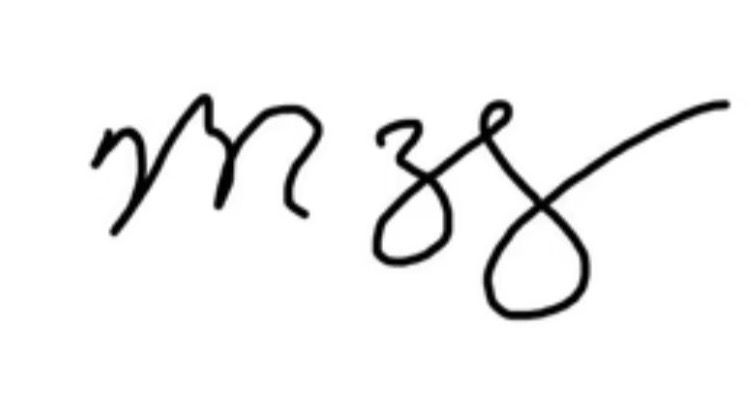
Mark Zuckerberg

Signature experts claim that people are too busy these days to sign their names legibly. Some psychoanalyze signatures. For example Mark Zuckerberg's signature is simply his initials, which means he's hiding out, doesn't have the time, too important. Zuck runs Meta, formerly and popularly known as Facebook.

Johnny Depp's signature looks like a bold hieroglyphic from another world. The challenge is to find any semblances of his name in his signature. He's an artist. You would think that an artist might be a little bit more clever with some hints. I wouldn't want it on my underwear.

Johnny Depp

Marylyn Monroe, sex symbol of the 1950s -- blond, curvaceous, voice like a cuddly baby doll -- had a mundane signature by today's standards. Easy to read. No frills, loops or runaway lines. Perhaps that was her true inner self: just an ordinary gal. She fooled us. Or maybe that was her unspoken allure. I'm delving now.

Marilyn Monroe

That's what's cool about signatures: they make you want to delve and interpret. But who has time for such trivial pursuits in a digital world where e-signatures will do the trick. I do.

According to my informed sources, your handwritten signature is never exactly the same. You could call it your organic mark, ever slightly changing, a simple breathing symbol of you and nobody else; when on a contract or document, a legally binding notation of one’s name.

I also found out that you can majorly change your signature, but not just on a whim one day and another whim the following day. You've got to be consistent. I've changed mine several times, going with my first two initials -- K.C. -- before my surname for the past 25 years. I've always been fond of the name, Kansas City (K.C.), even considered it as a name for a son or daughter. Luckily, I did not sire another child since I had that thought.

Out of curiosity and for inspiration, I searched out the signatures of figures from the past whom I admire, like Abraham Lincoln, Ernest Hemingway, F. Scott Fitzgerald, Albert Einstein, Hunter S. Thompson. Except for Hunter -- whose signature was as gonzo as he was -- their names were signed legibly with artistic flourish, similar to John Hancock's.

Hunter S. Thompson


I once owned a football decorated with signatures of L.A. Rams players, and I could read every one of them. No loopy, harried circles and cross hairs. What would be the point if you couldn't read their name? I have a baseball signed by pitcher (30-game winner) Denny McLain. A big and notorious man, Denny has a clear, simple signature.

A major regret is my losing a T-shirt that Jane Fonda signed for me, while I was wearing said T-shirt. We had attended the same Willie Nelson concert circa 1981. I knew I would never get that close to her again. 

Jane Fonda


In the distant future, who will be able to identify Johnny Depp's signature? Aliens from another world? Who was Johnny Depp, anyway?

My newly minted signature is legible yet artistic, it flows like water with curves representing iconic symbolism of yin and yang. It is deep and forward driven, while employing the laziness of a cool summer breeze and its author.

Still, I wouldn't have it on my underwear. Maybe on a paper napkin.


Saturday, September 23, 2023

Welcome Singapore!

Although Singapore is one of the most modern cities in the world (actually a nation-state), heritage buildings are treasured.

I don't know much about you, but from what I've read, you've got a very tidy nation with a rich, diverse culture. 

Let me begin with a huge "thank you" for viewing my blog -- more than 4,000 hits over the past 30 days!

My initial reaction was astonishment! What the hell?! Can you say, hell, in Singapore? I think you can. I know you cannot chew gum.

I understand that Singaporeans read body and facial expressions over the spoken word. I think that's cool. I wonder what you would think of a guy like former President of the USA Donald Trump?

You cannot believe a word he says, yet his body language says it all: lazy, unkempt, showy, overweight, troubled, insincere, arrogant.

We can take a lesson from you regarding communication. Although we can show you the value of free expression in which I can say such things about our government leaders.

Fun zone in Singapore

The closest I've been to Asia is Hawaii, where the population includes Pacific Islanders, Japanese, Taiwanese, Filipino, Burmese, Chinese as well as haoles, or white people. I find the Asian influence comforting, the people tend to be friendly and family oriented. 

I believe the ancients of the East -- characters like Confucius, Lao-Tsu and Buddha -- imparted great wisdom. I have been a devoted practitioner of Yoga for many years.

Your interest in my blog has created a desire in me to visit Singapore! I trust that we share a common spirit. On the other hand, your enormous interest could be an AI-type of robotic glitch, or ---- hack.

But let's not go there. If it is a hack, I have nothing worth hacking. I am a simple man. 

I am impressed by your breakdown of religions: 31-percent Buddhist, 19-percent Christian, 16-percent Muslim (predominantly Sunni),  9-percent Taoist,  5-percent Hindu. And 30-percent no religion, out of a total population of 4-million.

I find the Taoist religion most intriguing: the four principles being:

1. Simplicity, patience and compassion

2. Going with the flow -- when nothing is done, nothing is left undone

3. Letting go -- if you realize all things will change, there is nothing you will hold on to

4. Harmony.

I have learned of the Tao, or the Way, but didn't realize it was a practicing religion. I subscribe to those principles. As much as I can. My Western upbringing and our dominant culture in the U.S. are heavily slanted toward a materialistic reality, so it's not an easy row-to-hoe. Row-to-hoe is a metaphor that could possibly be compared, or I should say, contrasted, to the Way of Taoism.

I consider row-to-hoe more of a servile reference, as is the predominant principle of Western culture, again based on meritorious material gain rather than communal spiritual enlightenment.

I wonder if you've picked up this theme in my blogs? Perhaps that is what you find curious or interesting in my pieces? I prefer to believe that. If we can influence the world in this way, we may be able to save our planet.


I understand Singapore has been called a City in a Garden and is considered a green city and financial center of Southeast Asia. We had a friend who was sent there in the Eighties as an employee of a company called Seagate, an early tech company based in Santa Cruz County. Her work schedule prevented her from exploring your culture. She might as well have stayed in the US.

I hear there are many expats in Singapore and that board surfing is popular on your island. The waves are small but fun. Maybe that's how you heard about my blog? It was originally called Talking Surf Stories.

Established in the 13th Century, the name Singapore, originally Singapura in Sanskrit, means Lion City.  That's cool. I understand that Singlish is a slang spoken there, a combination of languages including English. I'd like to hear it.

Mahalo (thank you in Hawaiian) for checking my blog. I would enjoy hearing from you.

About chewing gum being out lawed in your country: The only gum I ever liked was bubble gum when I was a kid. I'm over that. I go with the flow.


Sunday, September 3, 2023

Changes in Latitude...

Jimmy Buffet early in his career, died Sept. 1 of a rare skin cancer Merkel cell carcinoma. PHOTO:GETTYIMAGES

The last thing I wanted to do was write another post about a friend who died. Then I heard that Jimmy Buffet had passed at age 76, one month older than I am. I hadn't heard of or thought about Jimmy in a while. I saw him perform live only once, and that was when he had become very popular. I wondered what's with all the Parrotheads.

There were no Parrotheads (Jimmy’s fans) when he recorded Let's Get Drunk or the Death of an Unpopular Poet, two songs on his first Dunhill studio album, A White Sports Coat and a Pink Crustacean. He knew how to turn a pun.

A year or so ago when Tina Turner passed, I mentioned to my late writer friend Rick Carroll that I had seen Tina at the Catalyst in Santa Cruz when she made her big comeback in 1982. Rick asked me if I had written about her. I hadn't. He said he would have liked to read what I had to say.

That's what friends who spend their time scribbling say to each other, which brings me back to Jimmy, who was, before all the tropical hoo-haw, first a writer.  Jimmy told stories with his songs. He had the gift of the pen. Before his music success, he wrote journalistic pieces for Billboard magazine. Jimmy ended up in Key West following a series of music rejections in Nashville. 

In the taverns of Key West, he discovered his muse while hanging and partying with writers including Truman Capote, Fred Neil, Jim Harrison and his brother-in-law novelist Tom McGuane, who wrote the liner notes for White Sports Coat… claiming the album fell somewhere “in the curious hinterland where Hank Williams and Xavier Cugat meet.”

Poet Kenneth Patchen was a favorite of Jimmy's who died with little fanfare. Jimmy's song Death of an Unpopular Poet was in honor of Patchen and fellow poet Richard Farina, both of whom were little known but dedicated to the craft.

It's a wistful tune. Jimmy saved it for a cool-down encore at the end of his shows. In the final verse, the poet gives his inheritance to his dog, leaving us with a wry smile.

I discovered Jimmy Buffet in the early Seventies when a new alternative radio station out of Gilroy, KFAT, introduced progressive country music to a local audience. Think Emilylou Harris and Rodney Crowell. Progressive country eventually morphed into a genre called Americana. 

KFAT worked a song into its regular playlist about getting drunk and screwing. It had a country flavor and ribald charm. Who is Jimmy Buffet? I thought when the singer’s name was announced.

It wasn’t exactly a Nashville voice. He was certainly drinking margaritas, but who knew, save for his Key West pals, much about the author and his environment of misfit wordsmiths.

Margaritaville changed that. It caught on like a raging kegger at a college frat party. It was fun yet self-deprecating. “Been here all season, don’t know the reason, nothing to show but this brand new tattoo…  stepped on a pop-top, blew out my flip-flop…

He could have been writing a jingle for a top-notch ad agency in New York, but it was a tad irreverent. The message was not to achieve status other than being a fun-loving bum in paradise. It was that simple.

The rest is history. With a winning smile and knack for clever phrasing, Jimmy created a deep brand worth nearly a billion dollars. Along the way he authored a series of popular sea-faring adventure novels. Granted, he needed a little sprucing up from his wife of 46 years, Jane Slagsvol. 

"He spun a billion dollar empire from a shaker of salt," according to columnist Maureen Dowd, another wordsmith pal of Jimmy's.

I bet his writer buddies were astounded by Jimmy's success. His go-ahead album that included Margaritaville says it all: Changes in Latitude, Changes in Attitude.

Thanks, Jimmy, for your uplifting spirit and wonderful stories.